Ward-Thomas Museum


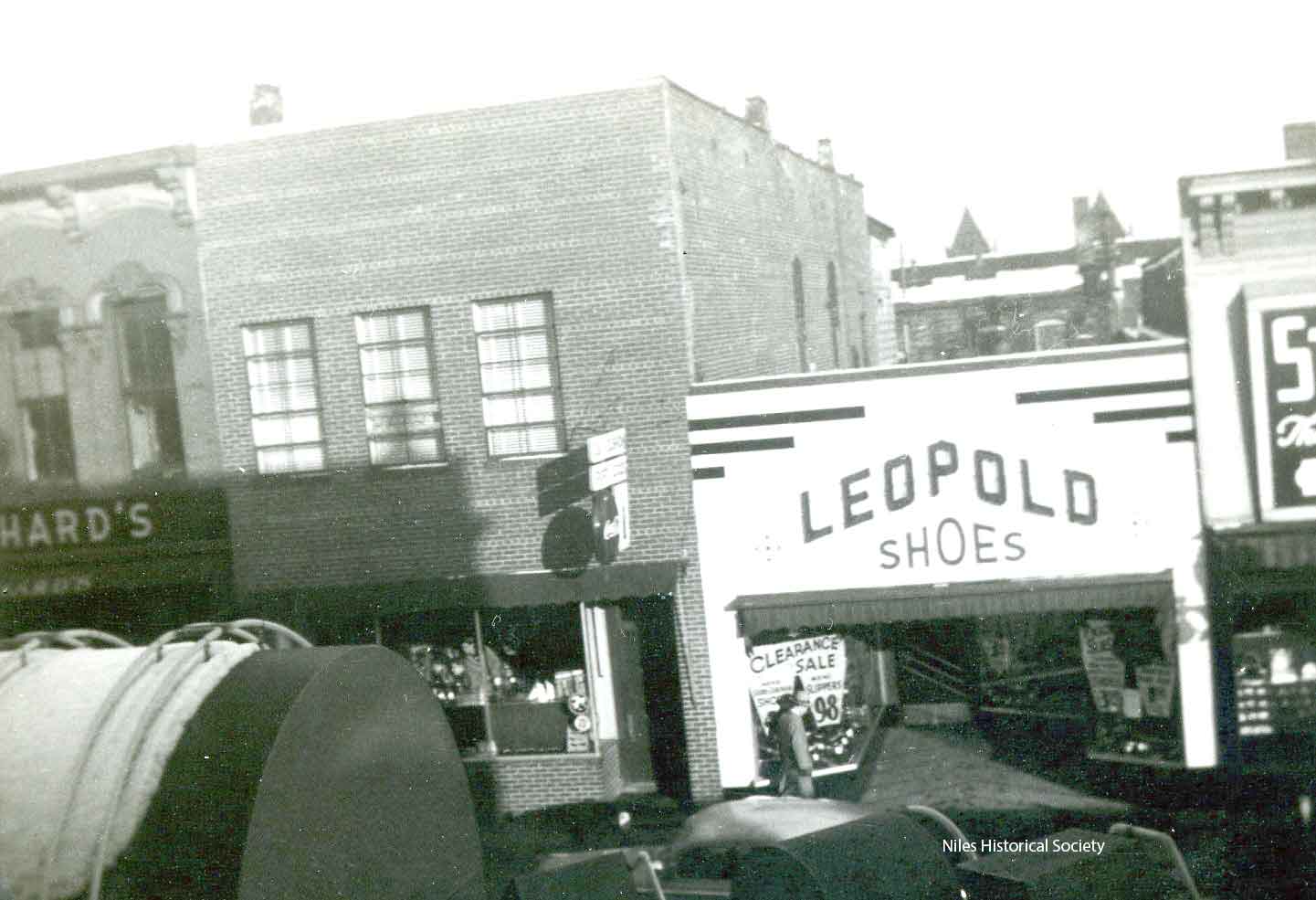
Leopold’s Shoe Store
Ward — Thomas
Museum
Home of the Niles Historical Society
503 Brown Street Niles, Ohio 44446
Click here to become a Niles Historical Society Member or to renew your membership
Click on any photograph to view a larger image, click on image again to zoom into photograph.
Leopold’s Shoe Store |
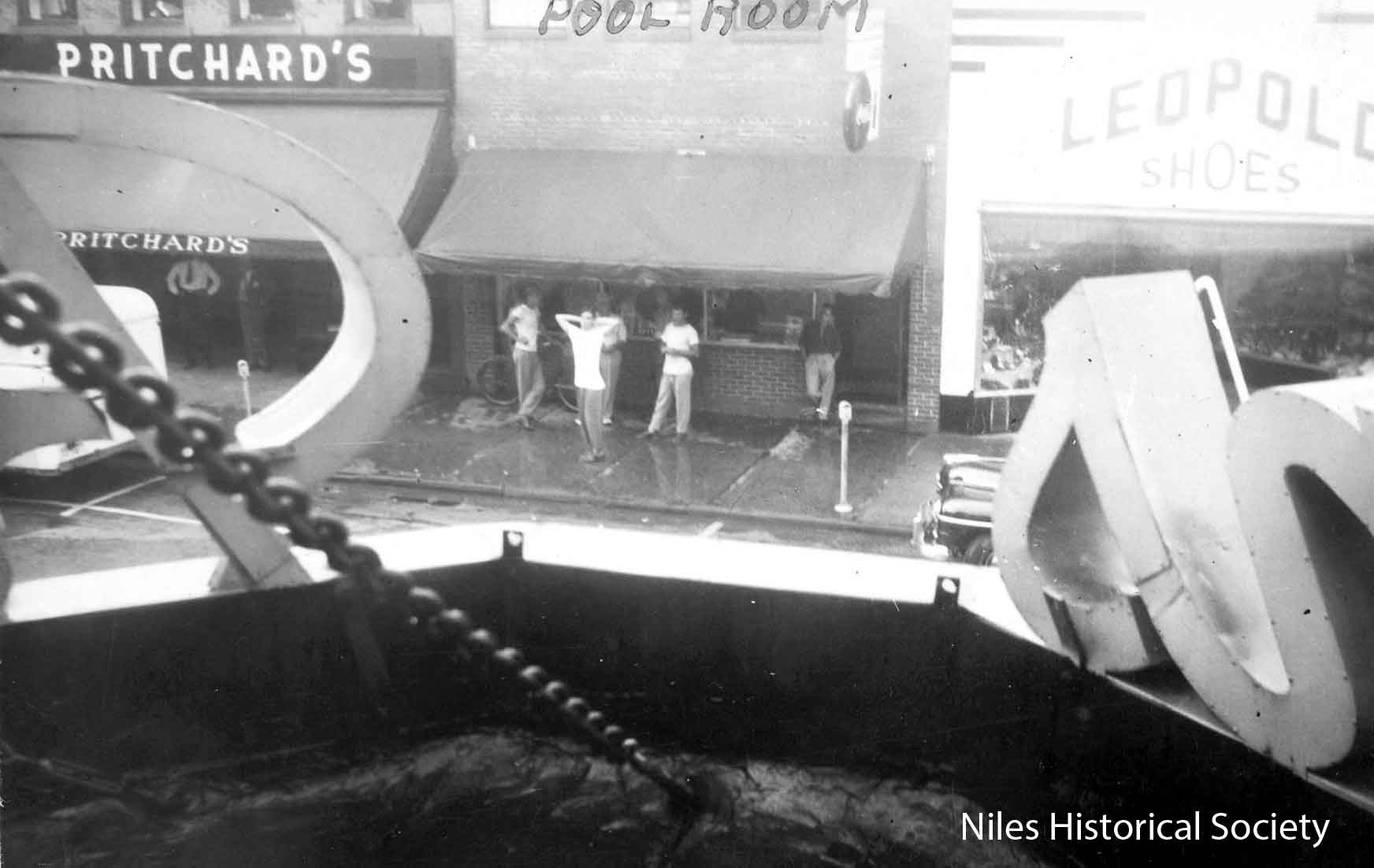
Pool hall beside Leopold’s Shoe Store |
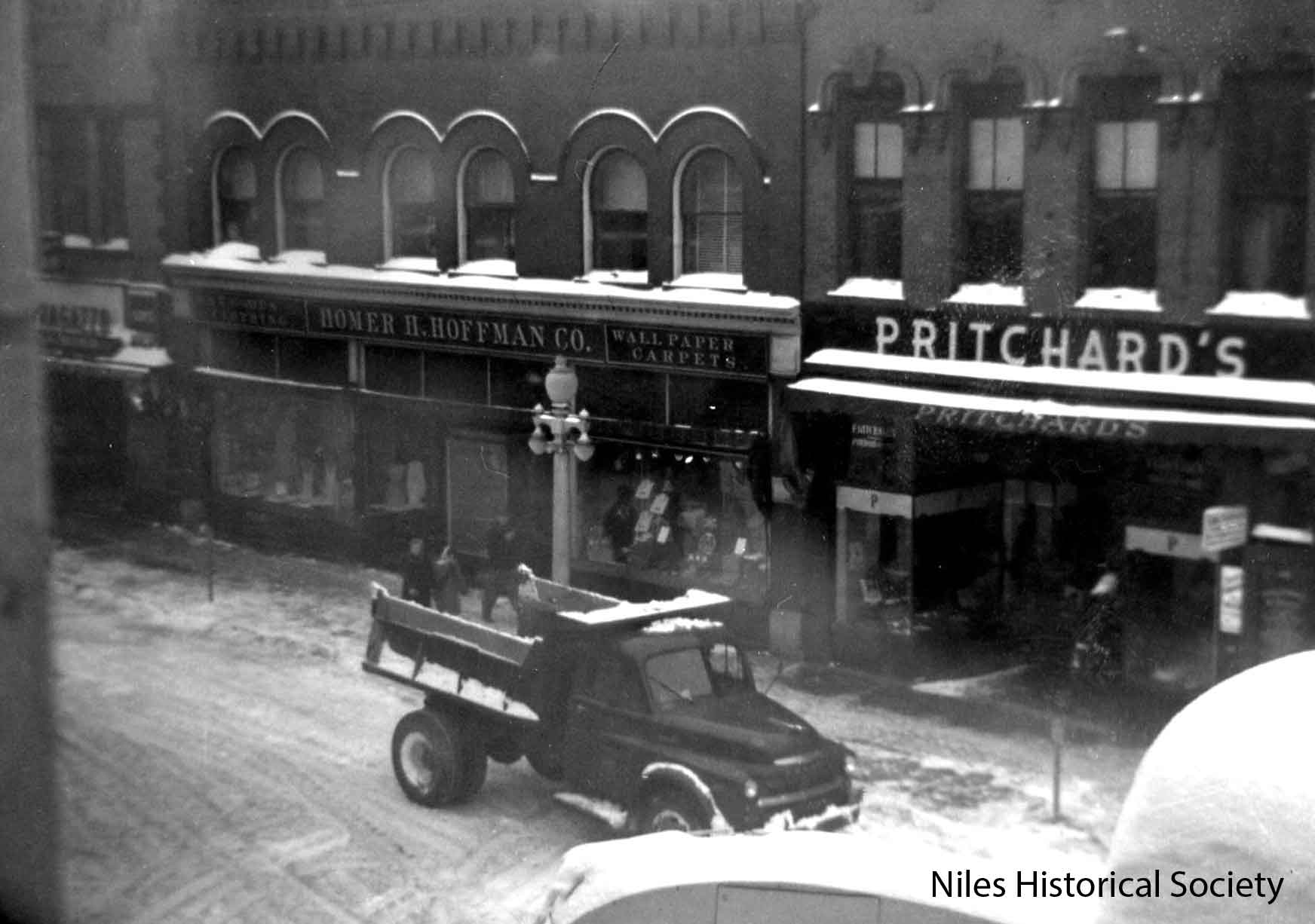
Pritchard’s and Hoffman’s Stores |
|
|
||
| The
Niles Standard July 14, 1939 Further building expansion in the business section of Niles was announced this morning by Albert Leopold, of the Leopold Shoe Store, when he gave out the details of the purchase of the Pritchard-Naylor building, 45 South Main Street. The building now occupying the premises and which was partially destroyed by fire a few weeks ago, will be torn down to make way for a modern storeroom which is to be erected. Work on the basement excavation will be started as soon as the old building is demolished, probably within a week. In announcing the real estate deal and building plans, Mr. Leopold stated that the new storeroom to be erected and occupied by Leopold & Son Shoe Store will be one of the finest and most modern in the Mahoning Valley. The building will be one-story and basement construction, and will be conservatively modernistic, with a 20-foot frontage and 100-foot depth. The front of the Leopold building will be entirely gray Carrara glass, with black trim. The architecture will be of such design as to make the new building have a two-story appearance. To dress up the front and add to the attractiveness, a new neon sign will be installed. Mr. Leopold stated that the new
building would be one which the City of Niles could feel proud.
Leopold’s is the oldest established shoe business in Trumbull
and Mahoning counties, having been in operation for the past 27
years, according to the statement of Mr. Leopold. The stock will
be all new, as Leopold’s are at the present time conducting
a removal sale, which will run for an indefinite time. |
||
| |
||
|
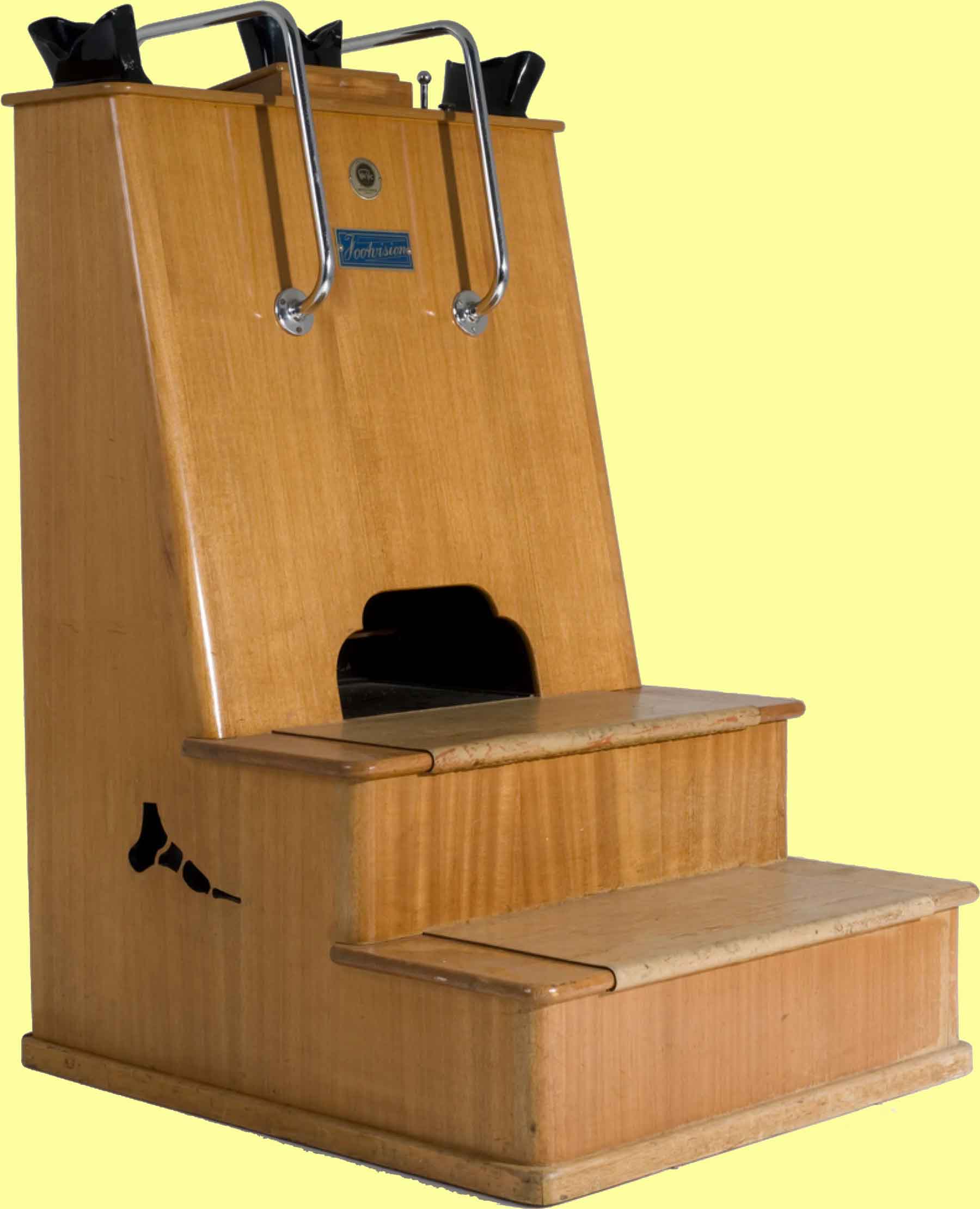
Shoe fitting flouroscope |
One of the memories of going to Leopold’s to purchase your new school shoes, was standing up on the foot x-ray machine that was in the center of the store. The shoe salesman, your mother and yourself could actually see the bones of your feet and how they fit in the shoes you were trying on. When children put their foot into the machine, they were effectively standing on top of the X-ray tube. According to experts, the machines generally employed a 50 kilovolt X-ray tube operating at 3 to 8 milliamps. The only shielding between your feet and the tube was a one millimeter thick aluminum filter. Some of the units allowed the operator to select one of three levels of intensity. There was also a push-button timer that allowed the salesman to set a desired exposure time, but most machines were set for 20 seconds. |
It was not unusual for a child to try on several pairs of shoes, increasing the exposure to the harmful x-rays. In 1946, the American Standards Association established a “safe standard of tolerance dose” that stated that the feet receive no more than 2 roentgen per 5-second exposure. In addition, children were not to receive more than 12 such exposures in a single year. As a result of this measure, manufacturers became concerned that their products would have to meet a myriad of standards that could vary from state to state. By the early 1950s, several professional organizations had issued warnings about the continued use of shoe-fitting fluoroscopes. By 1960 these events, plus pressure from insurance companies, led to the demise of the machine in the United States. |
| |
||
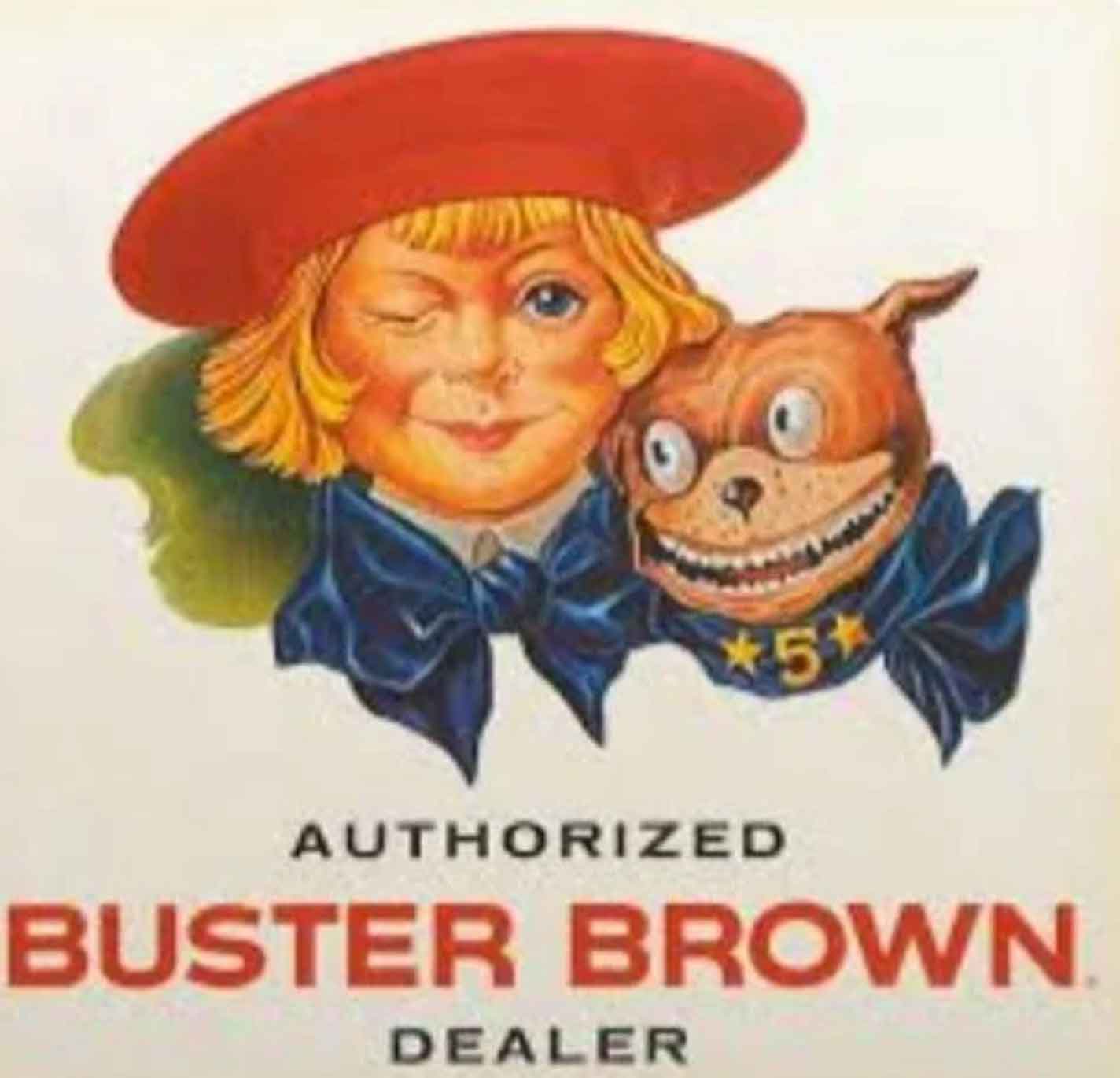
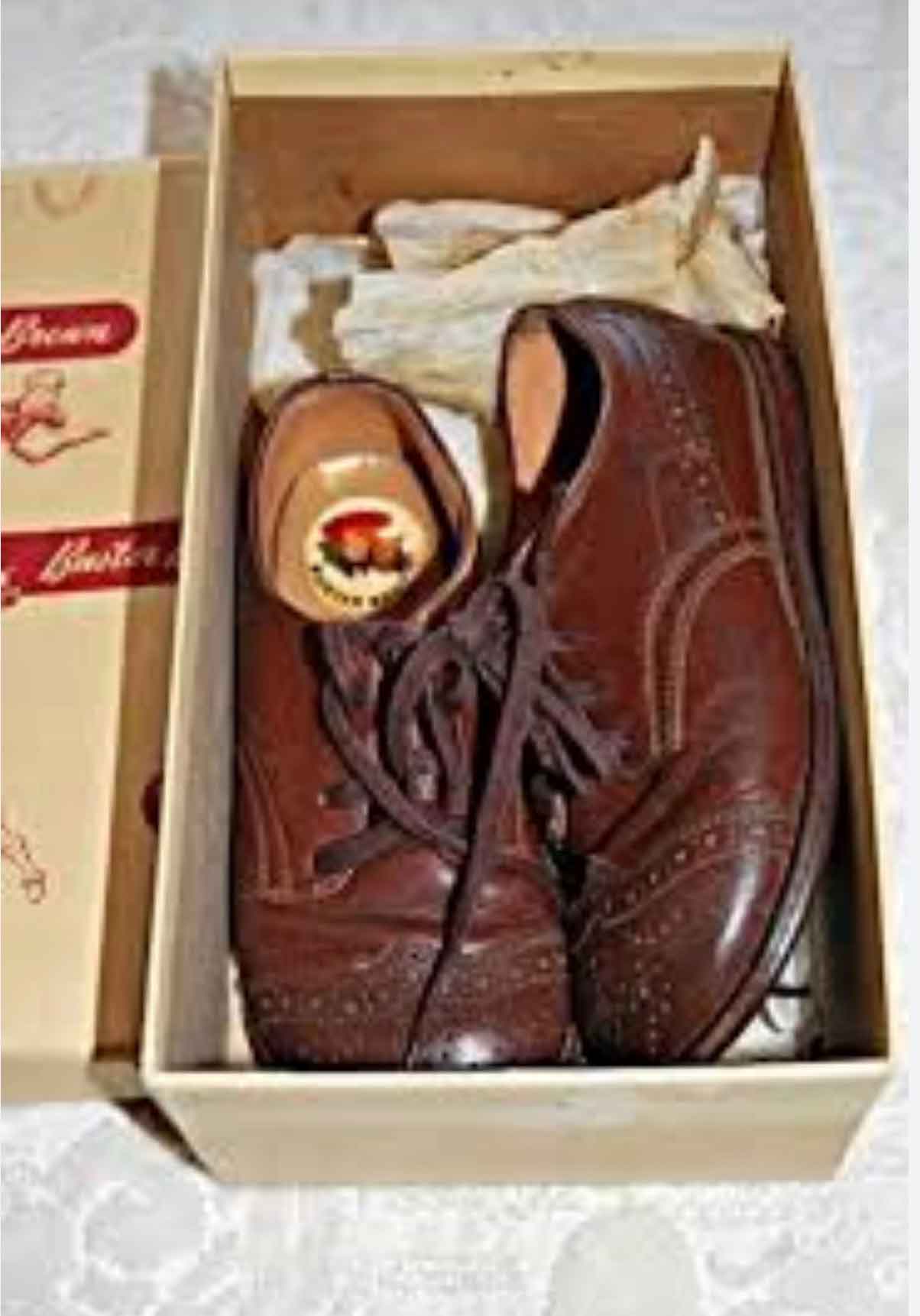
| Another memory about shopping for shoes at the Leopold Shoe Store is getting my first pair of Buster Brown shoes. Leopold's was the authorized Buster Brown shoe store in Niles. These shoes lasted forever, even though the young boy’s shoes lacked style. The girls had Mary Janes to choose from for their shoes. Buster Brown and his dog, Tige or Ty, on a shoe store was a big selling point as the logo was advertised in newspapers, radio and Television with a jingle: “I'm Buster Brown and I live in a shoe, and my dog, Tige, lives there with me too.” |
Buster Brown logo |
Boy’s Buster Brown shoes. |
|
|
||
|
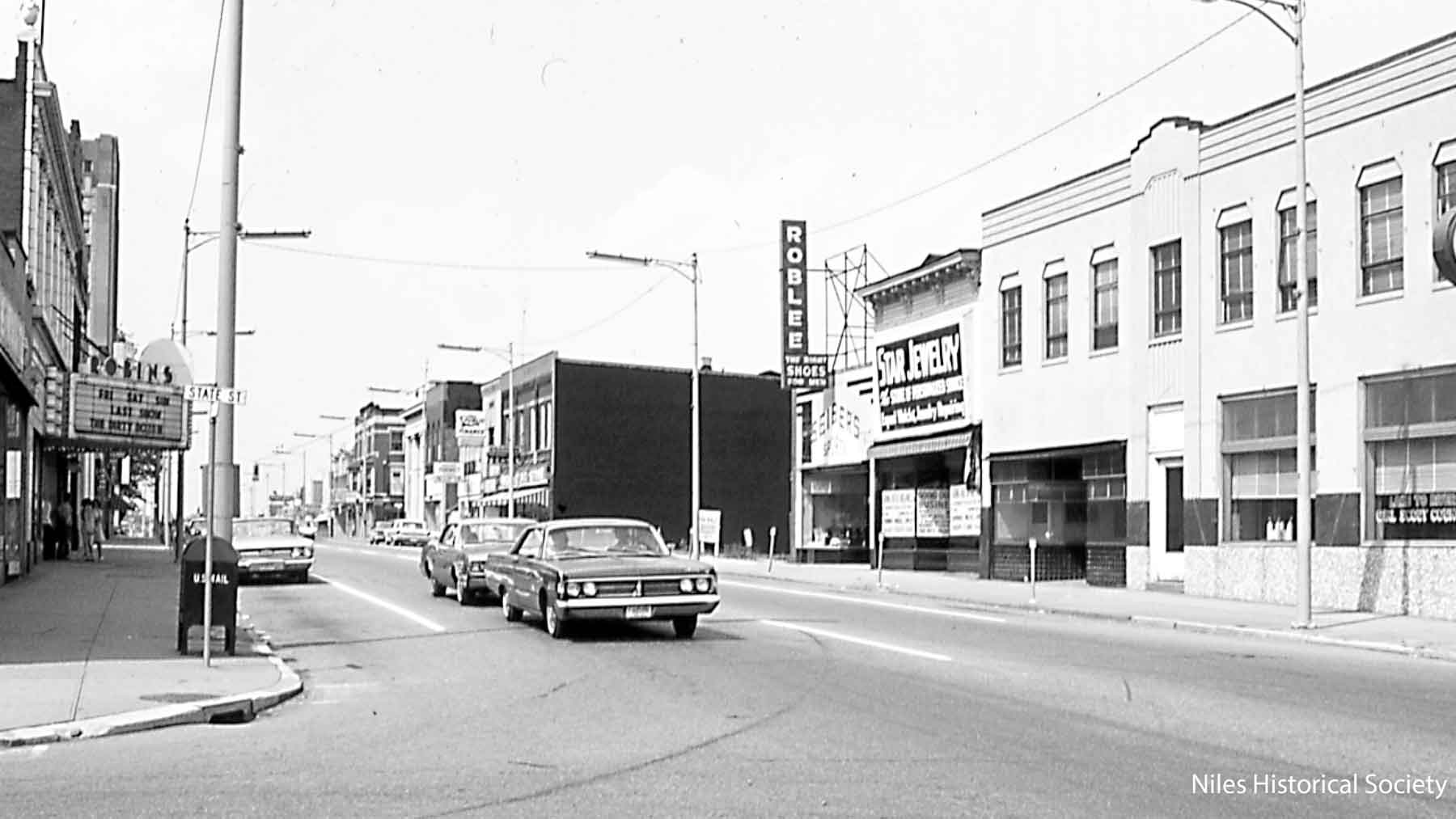
After Albert Leopold’s death, his store later was sold to Joseph Seiber who opened a sporting goods store. The store suppied the local high schools, especially Niles McKinley high school sports teams, with equipment and uniforms. This building survived the Hoffman fire in 1962 where three downtown stores were destroyed: Nick Ragazzo Shop and Pritchard’s Mens Wear and Hoffman's Department store. During urban renewal in 1975-76, all the buildings on the east side of South Main Street, with the exception of the bank building, would be demolished. |
|
| |
||
| Niles
Daily Times August 4, 1961 He opened his first shoe store in Niles, at the corner of State and South Main Streets, later moved to the buildings presently occupied by the F.W. Woolworth Company and in 1935 moved to the present location on South Main Street. Mr. Leopold also operated shoe stores in Warren and Ashtabula and formerly had stores in Youngstown and Struthers. He was the son of David and Rosa Hartz Leopold and moved to the Youngstown area 70 years ago. He was a member of Rodof Shalom Temple for over 60 years, and belonged to Youngstown Lodge No. 616 F. and A.M. 32nd Degree Masons, B’nai B’rth and Rodef Shalom brotherhood. Surviving is his widow, the former Emma Friedman; a son, Harold Leopold, of Youngstown; two daughters, Mrs. S.J. Shapiro of Warren and Mrs. Stanley Eppstein of Youngstown; three sister, Mrs. Blanche Mandell of Los Angeles, Mrs. Amelia Adler of New York, and Mrs. Helen Gluck of Warren. A brother, Benno Leopold of New York City; six grandchildren and one great grandchild. |
||
| |
||
|
|
||